Public perceptions of policy enforcement and illegal mining: Insights from three mining regions of Ghana
DOI:
https://doi.org/10.36005/jplm.v4i2.227Keywords:
Illegal mining, Galamsey, Policy enforcement, Deterrence theory, Institutional theory, Environmental GovernanceAbstract
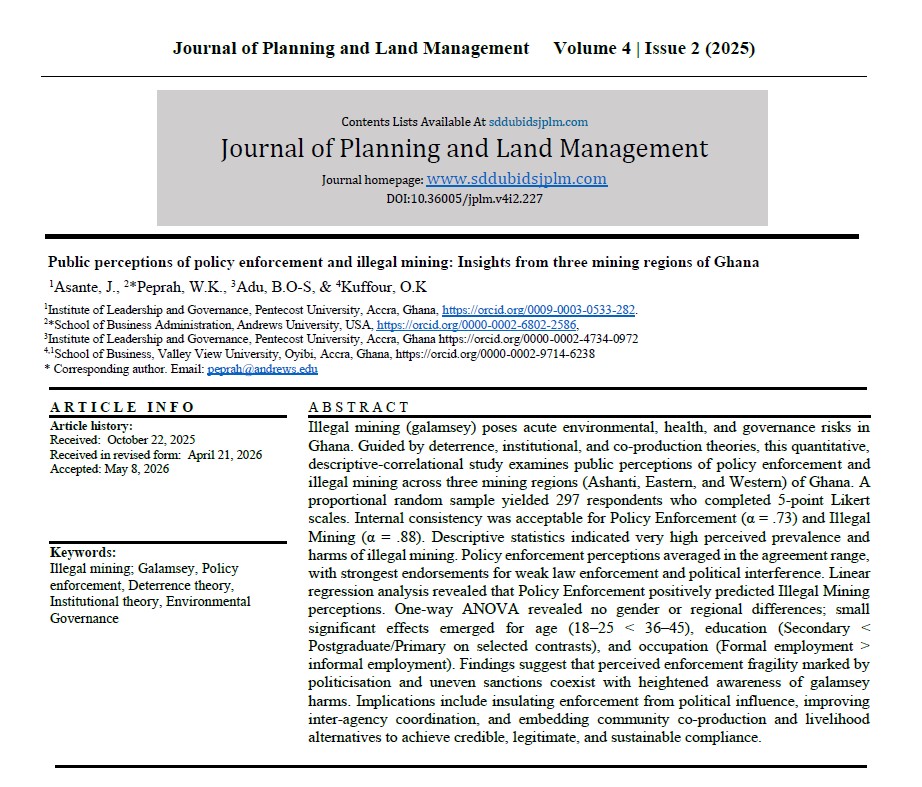
Illegal mining (galamsey) poses acute environmental, health, and governance risks in Ghana. Guided by deterrence, institutional, and co‑production theories, this quantitative, descriptive-correlational study examines public perceptions of policy enforcement and illegal mining across three mining regions (Ashanti, Eastern, and Western) of Ghana. A proportional random sample yielded 297 respondents who completed 5‑point Likert scales. Internal consistency was acceptable for Policy Enforcement (α = .73) and Illegal Mining (α = .88). Descriptive statistics indicated very high perceived prevalence and harms of illegal mining. Policy enforcement perceptions averaged in the agreement range, with strongest endorsements for weak law enforcement and political interference. Linear regression analysis revealed that Policy Enforcement positively predicted Illegal Mining perceptions. One-way ANOVA revealed no gender or regional differences; small significant effects emerged for age (18–25 < 36–45), education (Secondary < Postgraduate/Primary on selected contrasts), and occupation (Formal employment > informal employment). Findings suggest that perceived enforcement fragility marked by politicisation and uneven sanctions coexist with heightened awareness of galamsey harms. Implications include insulating enforcement from political influence, improving inter‑agency coordination, and embedding community co‑production and livelihood alternatives to achieve credible, legitimate, and sustainable compliance.
Downloads
Downloads
Published
How to Cite
Issue
Section
License
Copyright (c) 2025 Journal of Planning and Land Management

This work is licensed under a Creative Commons Attribution-NonCommercial 4.0 International License.