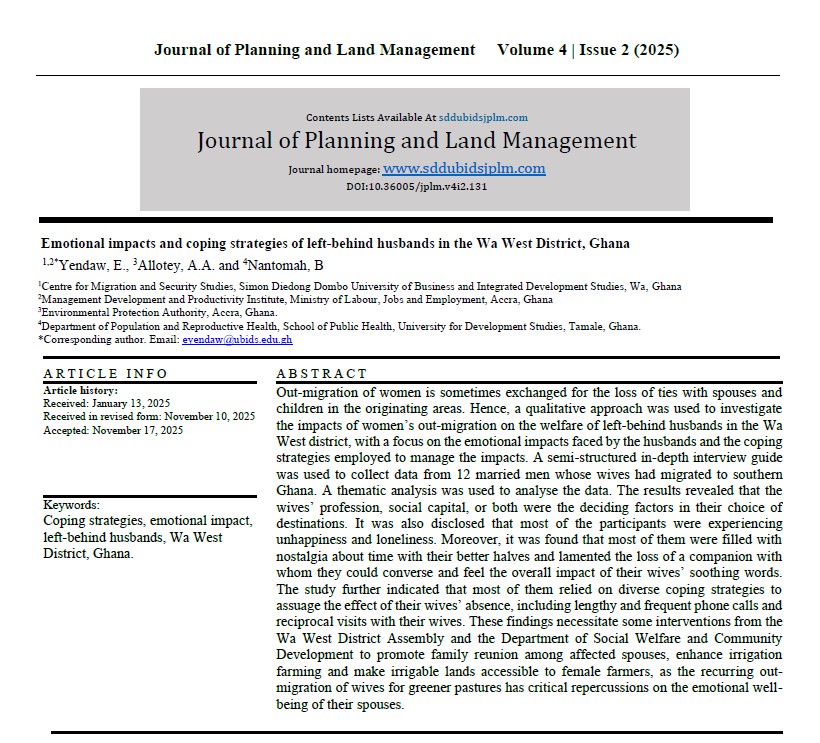
Emotional impacts and coping strategies of left-behind husbands in the Wa West District, Ghana
DOI:
https://doi.org/10.36005/jplm.v4i2.131Keywords:
Coping strategies, emotional impact, left-behind husbands, Wa West District, GhanaAbstract
Out-migration of women is sometimes exchanged for the loss of ties with spouses and children in the originating areas. Hence, a qualitative approach was used to investigate the impacts of women’s out-migration on the welfare of left-behind husbands in the Wa West district, with a focus on the emotional impacts faced by the husbands and the coping strategies employed to manage the impacts. A semi-structured in-depth interview guide was used to collect data from 12 married men whose wives had migrated to southern Ghana. A thematic analysis was used to analyse the data. The results revealed that the wives’ profession, social capital, or both were the deciding factors in their choice of destinations. It was also disclosed that most of the participants were experiencing unhappiness and loneliness. Moreover, it was found that most of them were filled with nostalgia about time with their better halves and lamented the loss of a companion with whom they could converse and feel the overall impact of their wives’ soothing words. The study further indicated that most of them relied on diverse coping strategies to assuage the effect of their wives’ absence, including lengthy and frequent phone calls and reciprocal visits with their wives. These findings necessitate some interventions from the Wa West District Assembly and the Department of Social Welfare and Community Development to promote family reunion among affected spouses, enhance irrigation farming and make irrigable lands accessible to female farmers, as the recurring out-migration of wives for greener pastures has critical repercussions on the emotional well-being of their spouses.
Downloads
Downloads
Published
How to Cite
Issue
Section
License
Copyright (c) 2025 Journal of Planning and Land Management

This work is licensed under a Creative Commons Attribution-NonCommercial 4.0 International License.