Farm-level agronomic practices among smallholder farmers in rural Ghana: Implications for climate change adaptation
DOI:
https://doi.org/10.36005/jplm.v4i2.188Keywords:
Smallholder farmer; local Knowledge; agronomic practices; climate change; adaptation Planning.Abstract
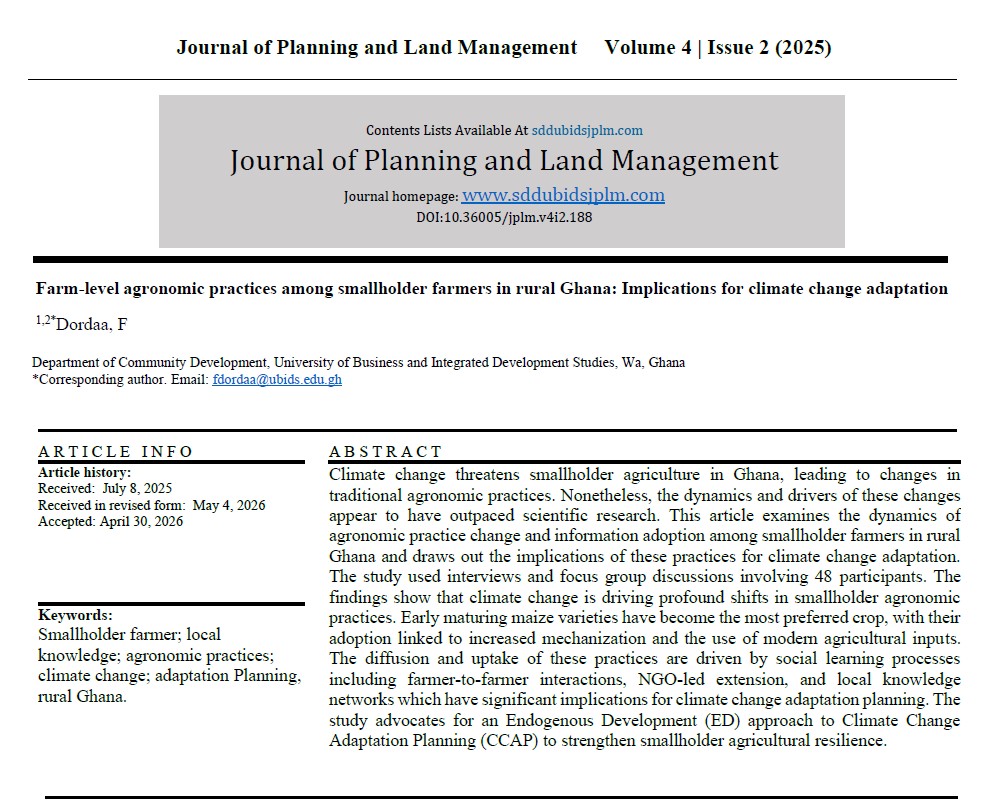
Climate change threatens smallholder agriculture in Ghana, leading to changes in traditional agronomic practices. Nonetheless, the dynamics and drivers of these changes appear to have outpaced scientific research. This article examines the dynamics of agronomic practice change and information adoption among smallholder farmers in rural Ghana and draws out the implications of these practices for climate change adaptation. The study used interviews and focus group discussions involving 48 participants. The findings show that climate change is driving profound shifts in smallholder agronomic practices. Early maturing maize varieties have become the most preferred crop, with their adoption linked to increased mechanization and the use of modern agricultural inputs. The diffusion and uptake of these practices are driven by social learning processes including farmer-to-farmer interactions, NGO-led extension, and local knowledge networks which have significant implications for climate change adaptation planning. The study advocates for an Endogenous Development (ED) approach to Climate Change Adaptation Planning (CCAP) to strengthen smallholder agricultural resilience
Downloads
Downloads
Published
How to Cite
Issue
Section
License
Copyright (c) 2025 Journal of Planning and Land Management

This work is licensed under a Creative Commons Attribution-NonCommercial 4.0 International License.